Temperature
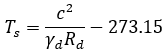
The sonically determined speed of sound is given in Eq. 6 and was found from the sum of the inverses of Eq. 2 and Eq. 3. The CSAT3C corrects online for the effect of wind blowing perpendicular to the sonic path. No additional off-line corrections are required as suggested by Liu, Peter, and Foken (2001).
|
|
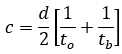
The speed of sound in moist air is a function of temperature and humidity and is given by:
|
|

where:
γ = ratio of specific heat of moist air at constant pressure to that at constant volume
P = pressure
ρ = air density
Rd = gas constant for dry air
Tv = virtual temperature
T = air temperature
q = specific humidity defined as the ratio of the mass of water vapor to the total mass of air (as in Kaimal and Gaynor 1991; Wallace and Hobbs 2006)
Note that γ is a function of specific humidity. It would be convenient if the effects of humidity could be consolidated into one term.
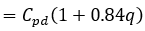
The specific heats for moist air at constant pressure and volume are given by:
|
|

|
|

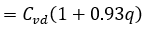
where, at constant pressure and volume, respectively (Fleagle and Businger 1980):
Cp and Cv = specific heat of moist air
Cpw and Cvw = specific heat of water vapor
Cpd and Cvd = specific heat of dry air
Substitute Eq. 8 and Eq. 9 into Eq. 7 and ignore the higher order terms. This yields
|
|

where:
Ts = sonic temperature
γd = ratio of specific heat of dry air at constant pressure to that at constant volume (Fleagle and Businger 1980; Kaimal and Gaynor 1991; Kaimal and Businger 1963; Schotanus, Nieuwstadt, and de Bruin 1983)
With Eq. 10, the effect of humidity on the speed of sound is included in the sonic temperature.
The sonic virtual temperature, in degrees Celsius, is given by Eq. 11, where γd = 1.4 and Rd = 287.04 JK-1 kg-1.
|
|