CR300 over IP to Konect
This type of network is useful for accessing a data logger remotely through a firewall, especially when the data logger, such as a CR300, lacks a CS I/O or Ethernet port.
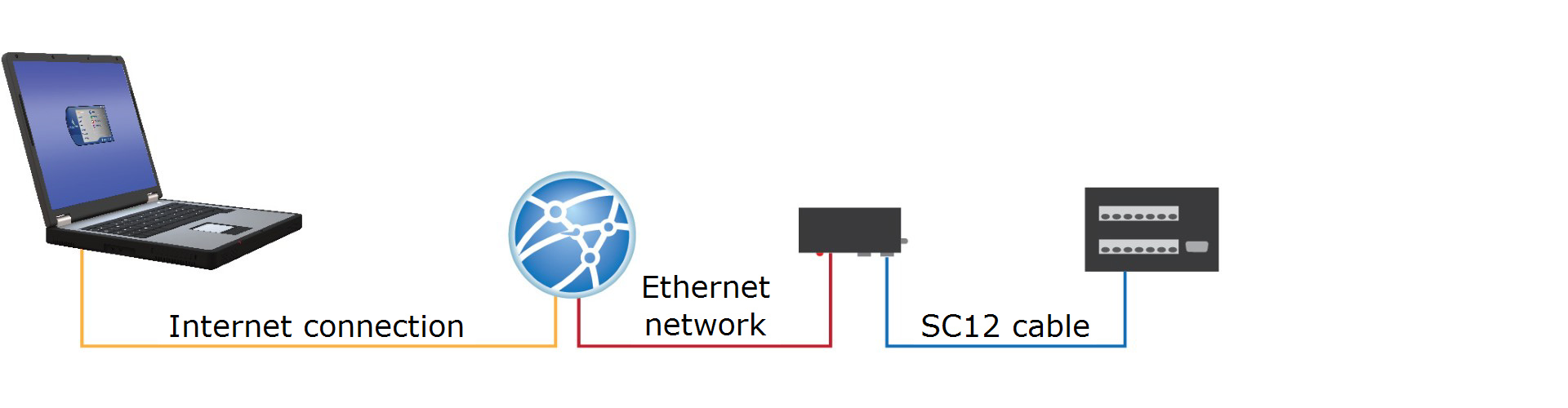
NL200/201 physical setup
-
Connect the data logger and NL200/201 RS-232 ports using a straight-through RS-232 pin to socket cable such as an SC12.
-
Apply 12 VDC power to the data logger and NL200/201.
Configure the NL200/201
-
Connect to the NL200/201 in Device Configuration Utility
-
Click the Factory Defaults button at the bottom of the Deployment window.
-
On the NL200 Series tab, set Bridge Mode to disable.
-
If a dynamic address is to be used, the network information acquired via DHCP can be seen on the NL200 Series tab under Status. The Status box also displays the MAC address of the NL200/201.
-
To enter a static IP address, select disable in the Use DHCP field. Then input the IP Address, Network Mask, and Default Gateway. These values can be provided by your network administrator.
-
On the RS-232 tab:
-
Set Configuration to PakBus.
-
Set Baud Rate to baud rate of attached device, generally this is 115200 (default).
-
Set Beacon Interval to 60 (seconds) and Verify Interval to 0. If you want to restrict communications paths, use the PakBus Neighbors Allowed setting to specify allowed neighbor addresses.
-
-
On the Network Services tab set:
-
The PakBus Address of your Konect PakBus Router. The default is 678.
-
The PakBus/TCP Client Connection Address to the Konect PakBus Router address.
-
The PakBus/TCP Client Connection Port to the Konect PakBus Router port.
-
The PakBus/TCP Password to the TCP Password configured on your Konect PakBus Router.
-
ICMP Ping to enable. For diagnostic purposes.
-
-
Click Apply to save the changes.
Configure the data logger (CR300)
-
Connect to the data logger in Device Configuration Utility.
-
Click the Factory Defaults button at the bottom of the Deployment window.
-
On the Datalogger tab verify that the PakBus Address is different than that set in the NL200/201.
-
On the Com Ports Settings tab set:
-
ComPort to RS-232
-
Beacon Interval to 60 (seconds)
-
-
Click Apply to save the changes and then close Device Configuration Utility.
Setup LoggerNet
-
In the LoggerNet Setup screen, click Add Root and select IPPort. Enter the Konect PakBus Router IP address and port number of the NL200/201. The Konect address was assigned when your account was setup. The IP address and port number are input on the same line separated by a colon. The fully qualified host name entry will look like xxxx.konectgds.com:6785.
-
Add PakBusPort (PakBus Loggers).
-
Enter the Konect PakBus Router TCP Password.
-
Add a PakBus Router (pbRouter). Enter 4070, the PakBus address associated with Konect PakBus Routers. Click Close.
-
Add another PakBus Router (pbRouter). Enter the PakBus address of the NL200/201. The NL200/201 default PakBus address is 678. Click Close.
-
Add the data logger and enter its PakBus address.
NOTE:The CR300 and NL200/201 must have different PakBus addresses.
-
Click Apply to save the changes.
-
Ensure that your computer is connected to the same network as the NL200/201.
-
You are now ready to connect to your data logger using LoggerNet. Select Main and Connect on the LoggerNet toolbar, select the data logger from the Stations list, then Connect. From there, you can view and collect data, or manage data logger settings.