VSPECT™
The uses Campbell Scientific VSPECT technology (U.S. Patent No. 7,779,690) to measure standard, single-coil-circuit vibrating-wire sensors. Learn about the patented Campbell Scientific VSPECT spectral-analysis technology at:

The patented VSPECT process uses frequency-domain analysis (including the use of Fourier transforms), interpolation, and digital signal processing (DSP) to identify and eliminate unwanted noise from the measurement. The process produces a very high-resolution frequency output.
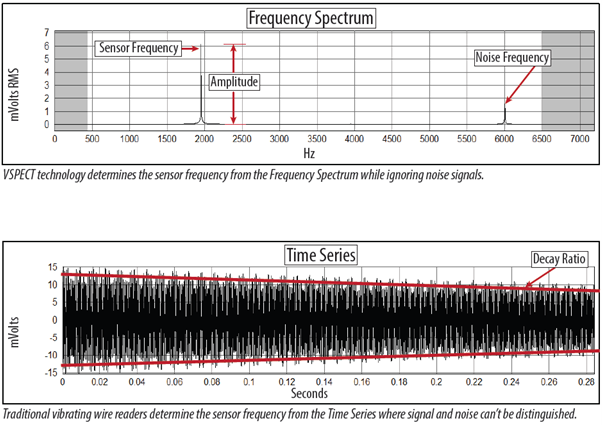
Since changes in temperature can impact the density of the vibrating-wire element of the sensor, a slight change in frequency is expected on the sensor as temperature changes occur. To compensate for this effect, many vibrating-wire sensors contain a built-in thermistor or other resistive temperature device. The resistance of the device is measured and converted to temperature. The temperature at the time of measurement is recorded and can then be used together with the frequency reading to calculate the value of the output phenomenon in engineering units (for example, measured value given with its dimensions or units of measure).
The following two sets of graphs illustrate the use of VSPECT to identify a sensor signal in a quiet and noisy environment. Both graphs were created from the same sensor using the Vibrating Wire Report created using a VWAnalyzer. The graphs on the left were generated from a sensor measured in an electrically quiet environment. The graphs on the right show an electrically noisy environment (AC power) similar to what can be seen in a field environment (power lines, motors, radio signals, etc.).
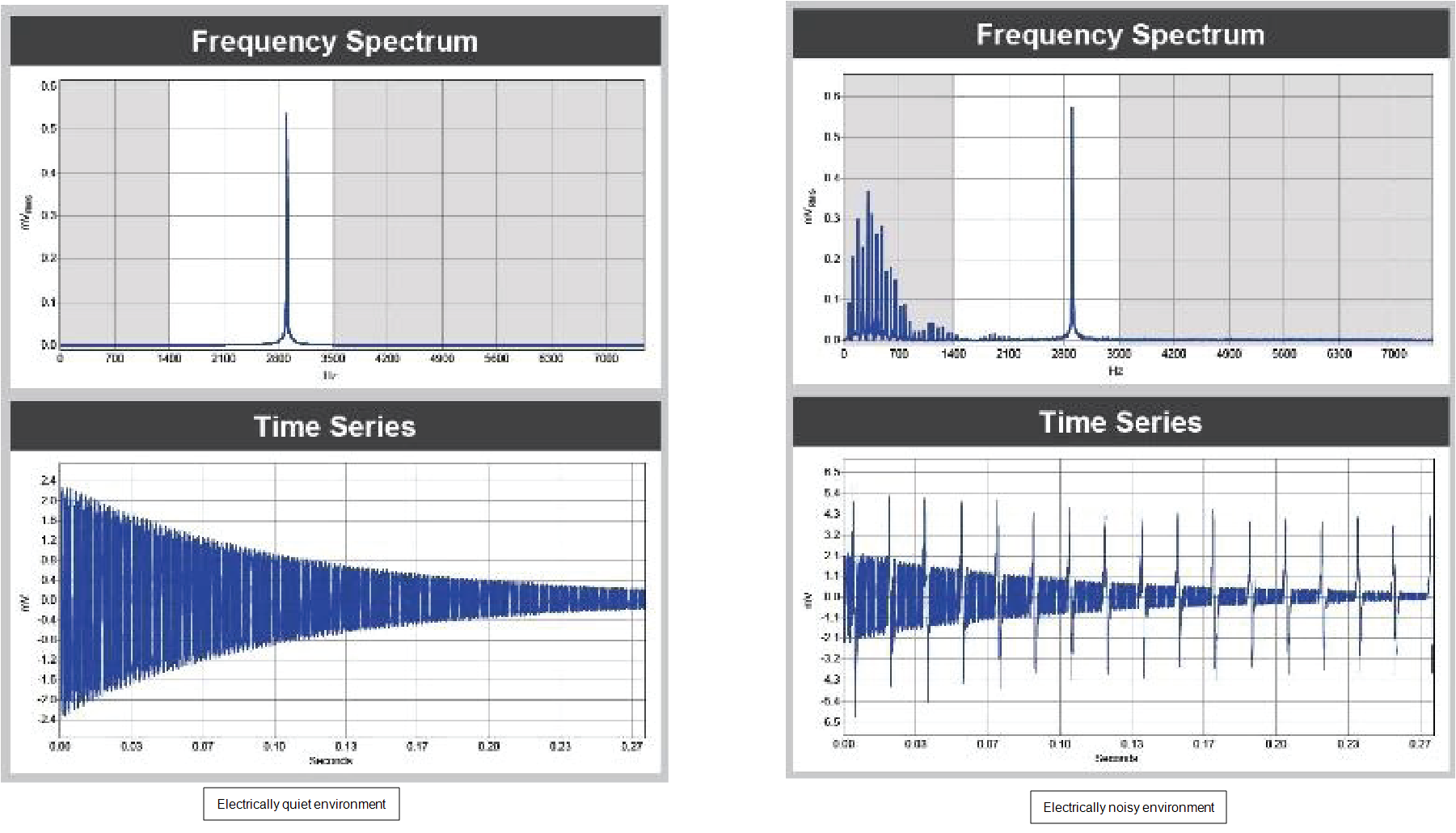
Vibrating wire signals
Vibrating wire readers that only use the time series to determine the frequency may report an incorrect frequency as a result of noise. The frequency spectrum (VSPECT) filters the noise and easily identifies the sensor signal. VSPECT provides noise immunity by correctly identifying the sensor signal and ignoring the influence of electrical noise that plagues time-domain-based vibrating wire readers.