Filtering to reduce measurement noise
An adjustable filter is applied to analog measurements, reducing signal components at selected frequencies. The following figure shows the filter frequency response. Using the first notch frequency (fN1) parameter, users can select the placement of the filter notches. The first notch falls at the specified fN1, and subsequent notches fall at integer multiples of fN1. Commonly, fN1 is set at 50 or 60 Hz to filter 50 or 60 Hz signal components, reducing noise from ac power mains.
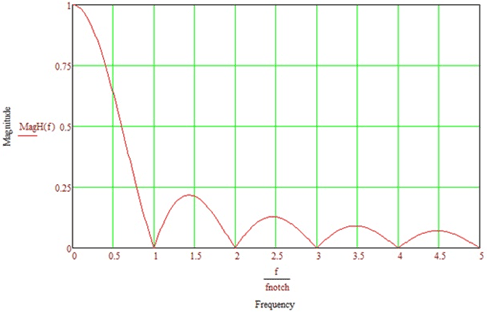
Filtering comes at the expense of measurement time. The time required for filtering is equal to 1/fN1. For example, setting fN1 equal to 50 will require 1/50 sec (20 ms) for filtering. As fN1 is set to smaller values, random noise in the measurement results decreases, while measurement time increases. The total time required for a single result includes settling + filtering + overhead.
Consult the following technical paper at www.campbellsci.com/app-notes  for in-depth treatment of measurement noise: Preventing and Attacking Measurement Noise Problems .
CR6 filtering details
The data logger utilizes a sigma-delta  ADC Analog to digital conversion. The process that translates analog voltage levels to digital values. that outputs digitized data at a rate of ADC Analog to digital conversion. The process that translates analog voltage levels to digital values.. Recall that averaging the signal over a period of 1/fN1 seconds will filter signal components at fN1 Hz. The final result, then, is the average calculated from
 fN1 is set to 50 Hz,
The actual fN1 may deviate from the user-specified setting since a whole integer number of samples must be averaged. For example, if fN1 is set to 60 Hz,